
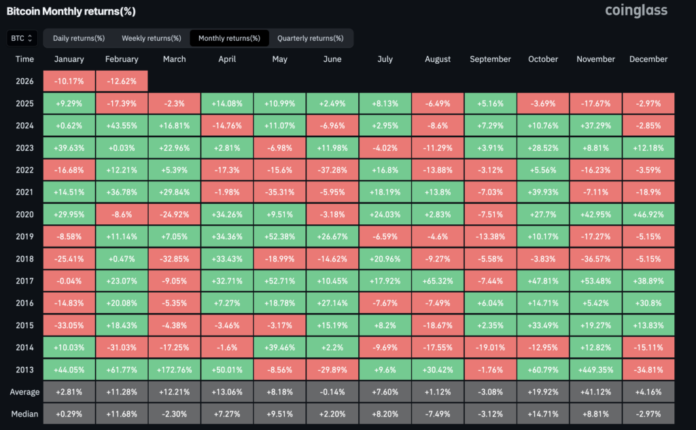
The scoop: Bitcoin is on pace for a fifth straight monthly drop if February closes red, its longest losing streak since 2018, while spot ETF flows flip persistently negative, reinforcing a new reality: post-ETF BTC is trading like a rates-and-risk instrument. If it doesn’t reverse in March and reclaim $80k, it will equal its worst period ever.
Bitcoin has closed lower in each of the past four months, and February is negative mid-month, setting up a fifth straight monthly decline.
That outcome would mark Bitcoin’s longest monthly losing streak in six years, a stretch now being framed less as chart trivia and more as a macro stress test for the post-ETF market structure.
Data shows October 2025 through January 2026 each finished down, with November’s loss the deepest in the run.
February opened near $78,626 before trading in the high $60,000s around mid-month.
As of press time. Bitcoin trades at approximately $68,800, about 44–45% below the October peak at $126,000, and 12.6% down for the month.
The all-time record for monthly drawdowns sits at 6 months from January 2017 to August 2018. Bitcoin would equal that record if March also ends negatively.
Rates expectations and ETF flows
The drawdown arrived alongside a repricing in rates expectations that has kept risk assets sensitive to each incremental change in the “higher for longer” path, according to Ned Davis Research figures cited by Business Insider.
Fed funds futures continue to lean toward a hold into March 2026, with odds heavily weighted toward no change.
A stickier policy path tends to raise the hurdle for duration-like trades, and Bitcoin’s recent correlation profile has left it trading as a macro beta expression in many portfolios, particularly when equity volatility rises.
That macro channel is now being reinforced by the ETF wrapper itself.
Recent spot Bitcoin ETF trading sessions are skewing negative, with roughly $2 billion in net outflows over the last 3 weeks and multiple single-day totals in the hundreds of millions.
In this regime, downside can persist without a crypto-specific catalyst if redemptions and risk-parity-style de-risking keep pressuring the tape.
On-chain cost basis defines key levels
Glassnode’s latest on-chain work frames the selloff as a tightening contest between overhead supply and cost-basis support.
The firm said the True Market Mean near $80,200 has acted as overhead resistance, while the Realized Price near $55,800 has served as historically confirmable “re-engagement” territory during deeper resets.
Between those poles, Glassnode maps a dense cost-basis zone around $66,900–$70,600, a band that has functioned as a near-term reference for whether holders are defending aggregate entry points or capitulating into lower-liquidity pockets.
Those levels provide a simple forward corridor for the next one to three months because they line up with what other market commentary is already watching.
I’ve suggested multiple times that the likely market bottom for this cycle sits around $49,000, and the sooner Bitcoin hits that level, the more likely it is to gradually climb back into the 2028 halving.
Barron’s described a $55,000–$60,000 area as a plausible volatility zone, pointing to the convergence of the 200-day moving average near $58,000 and an estimated average purchase price around $56,000 as potential anchors if selling accelerates.
Put differently, from roughly $68,800, the market is debating a path back toward the $80,200 “mean” area versus a slide toward the $55,800 realized-price region.
Each move represents a high-teens percentage swing.
| Path (next 4–12 weeks) | What would need to change | Levels in focus (sources) | Range framing |
|---|---|---|---|
| Stabilization and range trade | Outflows slow, macro does not tighten further, cost-basis buyers defend entries | $66,900–$70,600 support; ~$80,200 overhead (Glassnode) | ~$65,000–$82,000 (Glassnode) |
| Deeper deleveraging | Cost-basis band fails, risk-off persists, forced selling expands | $60,000 retest, then ~$55,800 realized price (Glassnode); $55,000–$60,000 zone (Barron’s) | ~$55,000–$60,000, with lower stress tails discussed below |
| Reclaim | Macro tone eases and inflows return, price recaptures overhead supply | Reclaim ~$80,200 (Glassnode) | ~$80,000–$95,000+ (level-dependent) |
The downside tails being circulated are also explicitly macro-linked.
Ned Davis Research, via Business Insider, framed a “crypto winter” stress case using prior bear-market averages (about 84% drawdowns over roughly 225 days), which would place Bitcoin near $31,000 if history were to rhyme at the extreme.
A separate Business Insider report cited a Zacks strategist outlining a $40,000 path over three to six months, tying the scenario to liquidity conditions and the duration of prior winter periods.
Those are not consensus targets, but they function as boundary markers for how far macro-driven de-risking can travel when flows and positioning are one-sided.
For the remainder of February, the calendar itself becomes the trigger.
A red monthly close would formalize a five-month run of declines and do so at a time when ETF flow persistence, on-chain cost-basis defense, and fed-funds pricing all point to Bitcoin trading as a rates-and-risk instrument rather than a standalone idiosyncratic market.